
Duplicated capabilities.
An agent builds a payments service in an afternoon. So does the agent two teams over. Nobody finds out until both are in production.
Architecture intelligence for teams building with AI agents
Nexarch is a living graph of your applications, data, dependencies and decisions. Your coding agents read it before they write, update it as they ship, and follow the rules you put in it. You get the map nobody had time to draw.
claude-code › nexarch_resolve_reference("payments")
✓ application:demo-project-payments
depends_on postgres, stripe-node
owner Platform team
→ reuse beats rebuild
An agent builds a payments service in an afternoon. So does the agent two teams over. Nobody finds out until both are in production.
Generated code wires systems together faster than anyone writes it down. The integration map in someone's head stopped being true months ago.
When architecture is generated rather than designed, nobody ever held the model in their head, including at the moment it was written.
Before you build
Every team already has the service someone is about to write again. The problem was never that people don't ask — it's that asking meant finding the right person, and being sure they'd remember. Nexarch answers it from what your estate actually contains, in the moment the question comes up, whether it's an engineer asking in chat or an agent asking before it writes a line.
claude-code › nexarch_resolve_reference("payments")
✓ application:demo-project-payments
nexarch_list_entities({ type: "application" })
→ 14 applications found · 3 related to payments
depends_on: postgres, stripe-node
→ reuse beats rebuild
Change, made visible
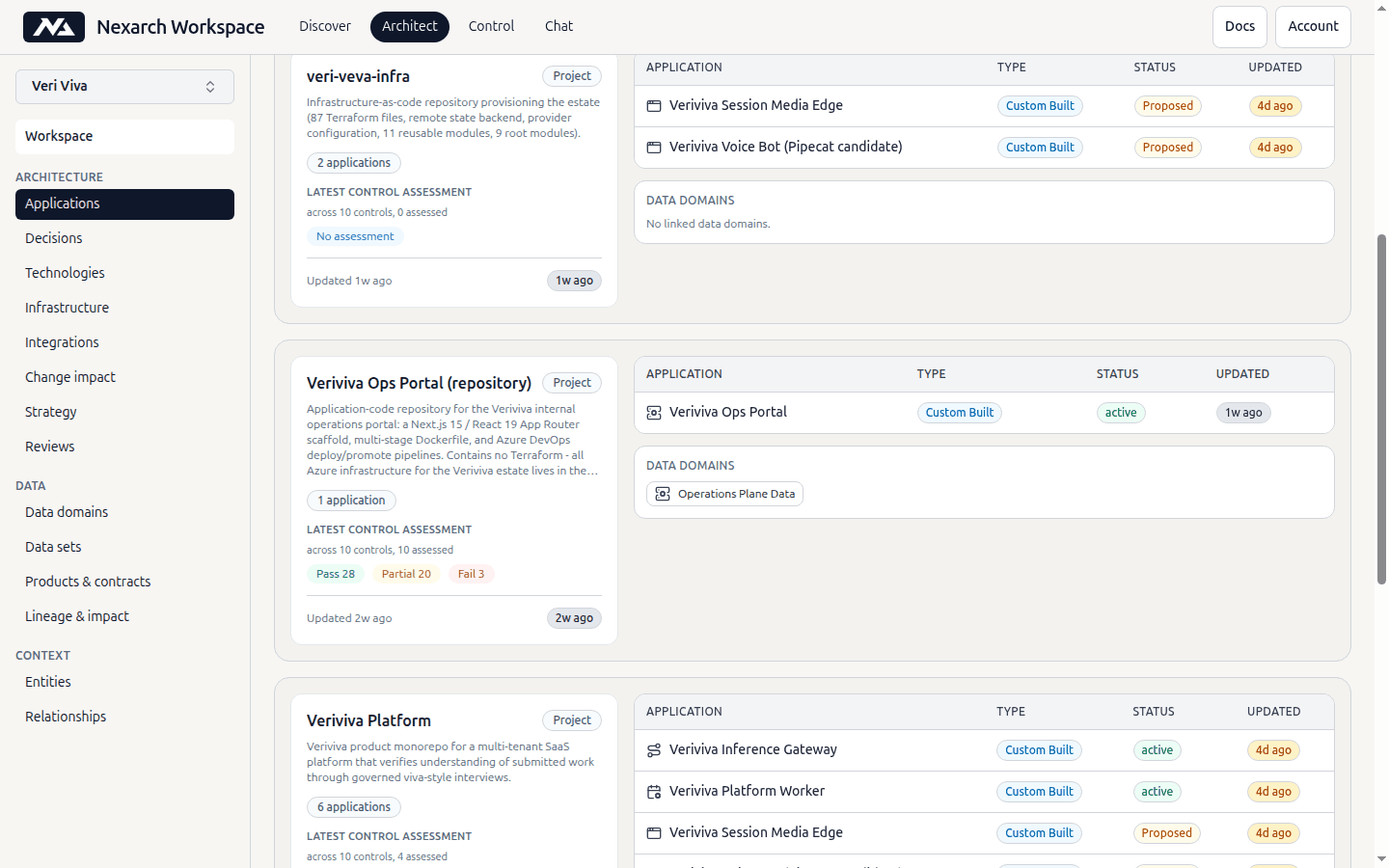
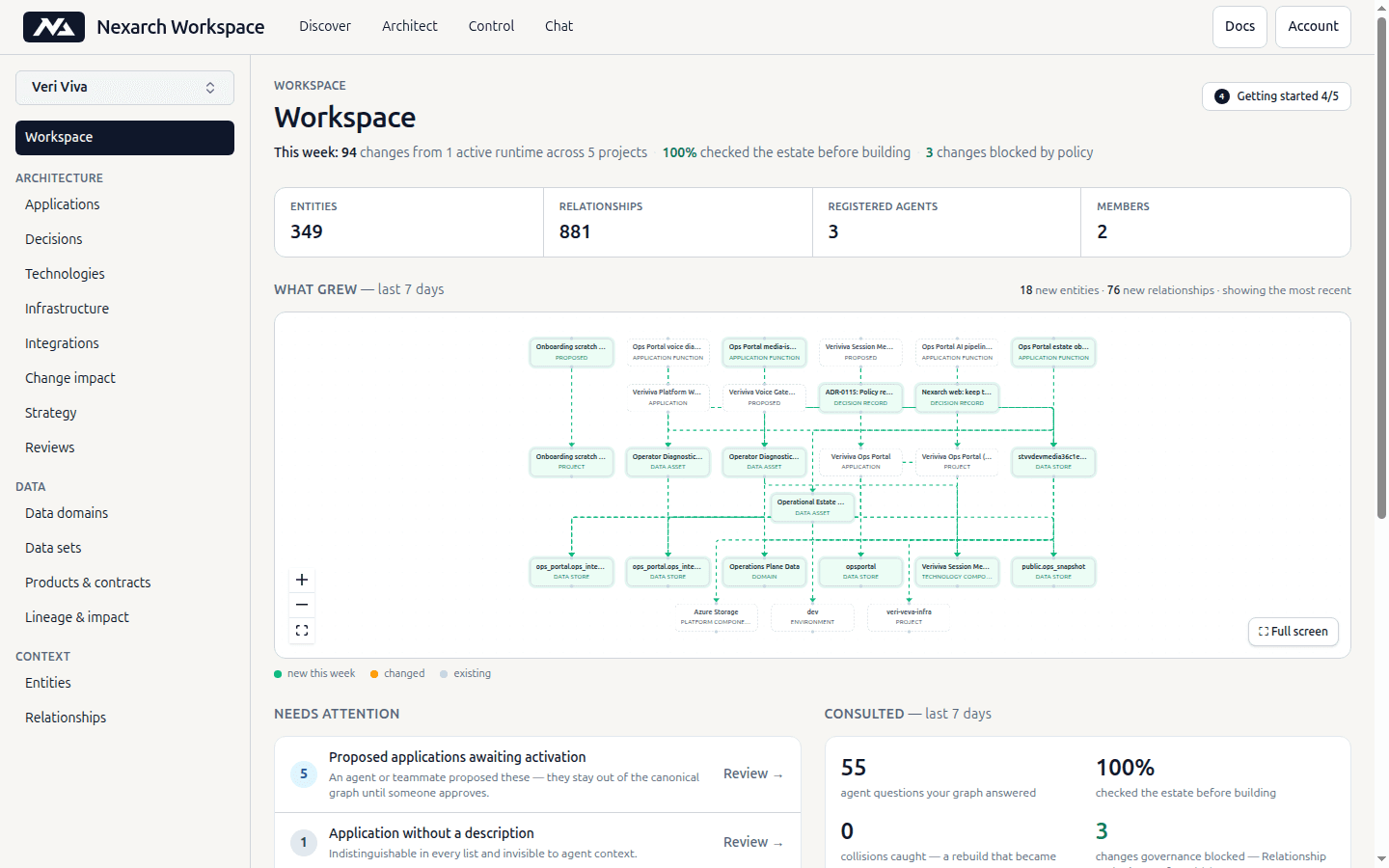
New applications, new data stores, new relationships, drawn as they landed. The dashboard tells you what needs attention: proposed applications awaiting activation, reference names nobody resolved, decisions past their review date.
Policy packs
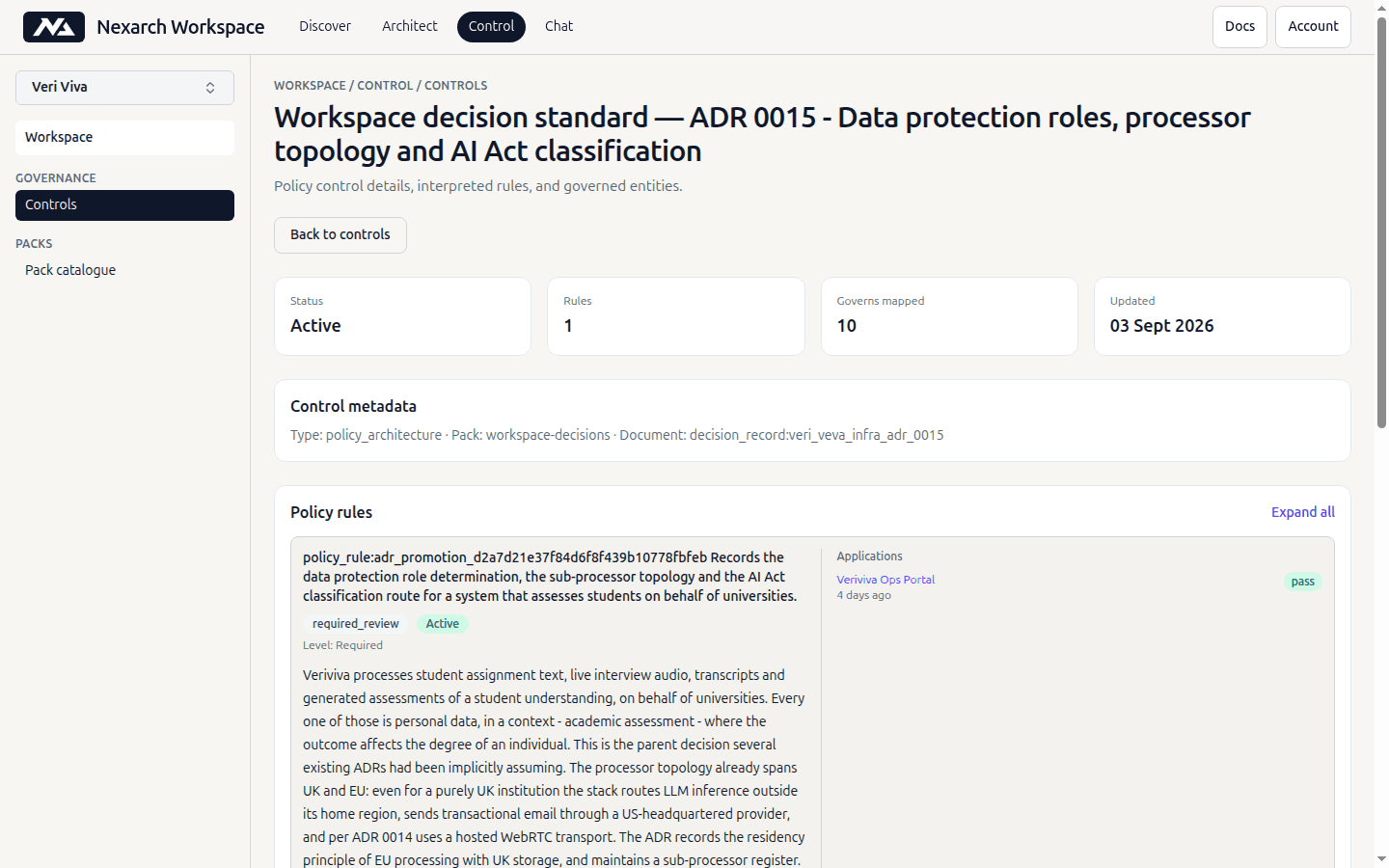
Policy packs define the standards: code, testing, documentation, security. Before an agent can write to the graph it must fetch the current policy bundle and present its hash with every change. Stale rules are refused. Audits show, per application and per rule, what passes, what is partial and what fails.
Decisions
Architecture decision records live in the graph next to the systems they govern. An agent that finds an ADR in a repository registers it. A decision made in a session is recorded there and then. Superseded decisions stay, marked as such, so the trail is never rewritten.
The renderer keeps policy packs portable and reviewable while the rule format is still evolving.
ADR-014 · source: docs/architecture/ADR-014.md
asserted by claude-code · repository: demo-project/platform
Get started
Nexarch connects to the coding agents you already use. There is no integration project.
Step 1
npx nexarch@latest setupYour terminal
Run once in your terminal. Signs you in if needed, configures your MCP clients, writes agent instructions into this directory and registers this agent. Its identity is captured in the next step.
Step 2
Please run 'npx nexarch@latest init-agent'Via your agent
Ask your coding agent to run this once. It completes the identity handshake so Nexarch records the real provider, model and client it governs. If it offers to write instructions into the repo, it must ask you first.
Step 3
Please run 'npx nexarch@latest init-project'Via your agent
Ask your agent to run this in the repository. It registers the project and proposes its applications for review; registration finishes when the agent runs the enrichment steps the command returns.
Closed beta
Tell us about your team and what you'd want Nexarch to prove. Requests are reviewed by a person, usually within two business days. Workspaces shine with several engineers, so bring colleagues.
Request beta access